united states marine dress uniform Original U.S. WWI Army Officer Engineer Named Painted Trunk Grouping –  International Military Antiques
SKU: 95144182496
united states marine dress uniform

united states marine dress uniform Original U.S. WWI Army Officer Engineer Named Painted Trunk Grouping – International Military Antiques

Sale price$22.32 Regular price$24.80
Save 10%
Size: 4

Pay in installments of $6.20 with ShopPay, AfterPay and Klarna

Shipping Estimate
USA
  • USA
  • CAN

Ships within 48 hours · Estimated delivery Jun 30 - Jul 5

Promo Codes Available:

For Your Every Summer RSVP, with Code: SUMMER15

Description

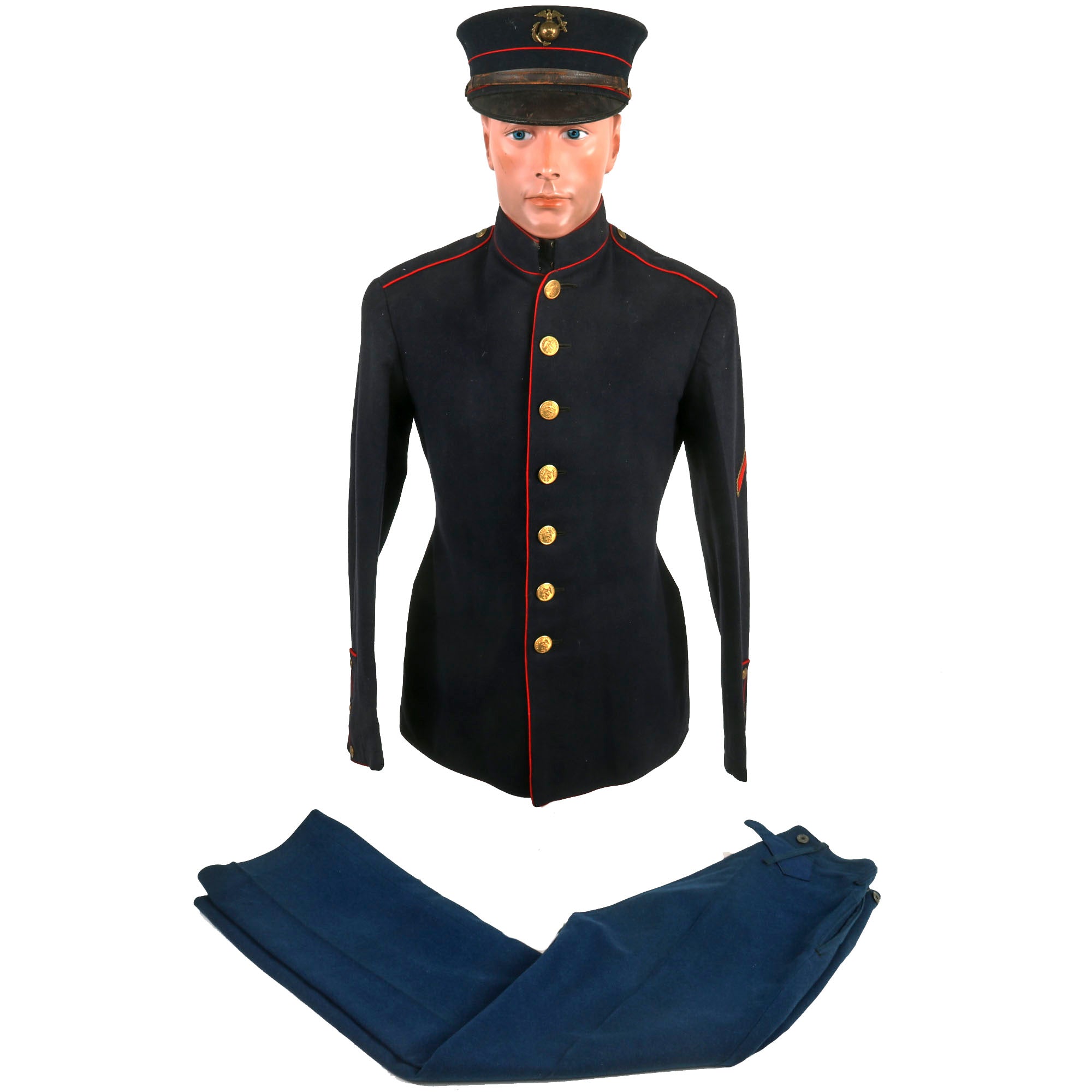
united states marine dress uniform Original U.S. WWI Army Officer Engineer Named Painted Trunk Grouping – International Military AntiquesOriginal Item: Only One Available: This is an example of the iconic USMC M1912 Dress Blue uniform with the rare Bell Crown service cap. All buttons are retained and everything is in fantastic condition. This model of tunic and service cap are integral for any USMC or WWI US Collection. This is a full M1912 U. S. Marine Corps Uniform, including the M1912 dress tunic, dress breeches, and the dress Bell Crown service cap, named to Private John M. Powell,

Original Item: Only One Available: This is an example of the iconic USMC M1912 Dress Blue uniform with the rare Bell Crown service cap. All buttons are retained and everything is in fantastic condition. This model of tunic and service cap are integral for any USMC or WWI US Collection.

This is a full M1912 U.S. Marine Corps Uniform, including the M1912 dress tunic, dress breeches, and the dress Bell Crown service cap, named to Private John M. Powell, USMC. The tunic and pants are both near mint, in fantastic condition with one discharge chevron on the right sleeve. The pants are stenciled “J.M. POWELL” on the interior. The Bell Crown service cap has a full sweatband, partially ripped but still intact. The cap features a black leather brim, supported by pressed paper or fabric. The red piping trim was added when the 1912 model was patterned. The EGA is affixed to the front and is period correct with both latitude and longitude lines on the globe. The chinstrap is beautifully worn in a way that compliments the entire uniform. The cap has one or two tiny moth nips but is otherwise flawless on the exterior.

John M. Powell enlisted in the Marine Corps on December 12th, 1917, likely hoping to make it to France before the war was over. He was stationed at the Naval Ammunition Depot in New London, Connecticut for most of his time in the service.

Approximate Measurements:
Collar to shoulder: 10"
Shoulder to sleeve: 25”
Shoulder to shoulder: 16”
Chest width: 18"
Waist width: 17"
Hip width: 21.5"
Front length: 30.5"

Pants:
Waist: 15.5"
Inseam: 31"

The United States Marine Corps
The decades following the War of 1812 saw the Marines protecting American interests around the world, in the Caribbean, at the Falkland Islands, Sumatra and off the coast of West Africa, and also close to home in operations against the Seminole Indians in Florida.

During the Mexican War (1846-1848), Marines seized enemy seaports on both the Gulf and Pacific coasts. A battalion of Marines joined General Winfield Scott's army at Pueblo and fought all the way to the "Halls of Montezuma," Mexico City. Marines also served ashore and afloat in the Civil War (1861-1865). Although most service was with the Navy, a battalion fought at Bull Run and other units saw action with the blockading squadrons and at Cape Hatteras, New Orleans, Charleston, and Fort Fisher. The last third of the 19th century saw Marines making numerous landings throughout the world, especially in the Orient and in the Caribbean area.

Following the Spanish-American War (1898), in which Marines performed with valor in Cuba, Puerto Rico, Guam, and the Philippines, the Corps entered an era of expansion and professional development.

It saw active service in the Philippine Insurrection (1899-1902), the Boxer Rebellion in China (1900). and in numerous other nations, including Nicaragua, Panama, Cuba, Mexico, and Haiti.

Between 1900 and 1916, the Marine Corps continued its record of participation in foreign expeditions, especially in the Caribbean and Central and South America, which included Panama, Cuba, Veracruz, Haiti, Santo Domingo, and Nicaragua.

Shipping Notes
  • Free Standard Shipping on $100+ Orders to the USA.
  • Except Preorder products are shipped in 48 hours.
  • Delivery to the USA:
  1. Standard Shipping : 3-10 business days
  • If time is of the essence, please consider selecting expedited delivery for faster service.
Exchange/Return Notes
  • We offer a 30-day return/exchange service after receiving.
  • Final sale items are not eligible for returns or exchanges.
  • To process your return/exchange, please contact us at [email protected]
  • Please click here for more details>>> Return & Exchange Policy
SKU: 95144182496

Discover Niche Categories That Outsell united states marine dress uniform

Top-Converting Item to Boost Your Average Order

4.2 ★★★★★
Based on 1629 reviews
Sort
Highest Rating
Newest First
Oldest First
Product Reviews
D
Verified Purchase
Don Morris
Los Angeles, US
★★★★★ 5
"Racial Capitalism"
Format: Paperback
Cedric J. Robinson’s Black Marxism is first a history of Black people appearing in historical texts as far back as Herodotus (c. 484 – c. 425 BCE) in ancient Greece, and second a history of “the collisions of the Black and white ‘races’ beginning in the fifteenth and sixteenth centuries.” Robinson’s thesis connects the evolution of capitalism to its roots in racism (racialism) understood in broad terms to comprise the subjugation of one class/group/nation/race by another (the Irish by the English in the nineteenth century, for example). He uses the term “racial capitalism” to express this process—the necessity of opposing classes for the function of capitalism. As a result, “racialism,” he says, “would inevitably permeate the social structures emergent from capitalism.” Keynes attributed the slow change in the “standard of life of the average man” until the beginning of the eighteenth century to “the remarkable absence of important technical improvements and to the failure of capital to accumulate.” Capital is accumulated, in Marx’s view, through the accretion of “surplus labor” which is the extra time a worker “must add to the working time necessary for his own maintenance . . . in order to produce the means of subsistence for the owners of the means of production.” Robinson ties capitalism’s early exploitation of surplus labor to slave labor and the slave trade noting, “historically, slavery was a critical foundation for capitalism.” Robinson traces the forced transport of Black people from Africa (the diaspora) to Europe, as well as Central, South, and North America as a foundation of early capitalism (and slavery as its form of “primitive accumulation” of capital). In his discussions of slavery, Robinson stresses the sense of the enslaved people with respect to their captors in terms of the slaves’ resistance, hostility, and defiance of the masters—their “Black radicalism.” As Robinson’s text approaches the twentieth century and the influence of Marx, his focus narrows to the significance and character of specific Black leaders including W. E. B. Du Bois, C. L. R. James, and Richard Wright and their respective connections to Marxism’s diverse interpretations. Marxism, says Robinson, “has proven insufficiently radical to expose and root out the racialist order that contaminates its analytic and philosophic applications or to come to effective terms with the implications of its own class origins.”
WAS THIS REVIEW HELPFUL?YesReportShare
Reviewed in the United States on September 2, 2022
E
Verified Purchase
Emma
Dallas, US
★★★★★ 5
Any socialist movement must centrally address racial liberation to succeed.
Format: Kindle
Robinson's masterwork powerfully demonstrates how the Black radical tradition emerged from the shared experiences of resistance to racial capitalism and colonialism. By tracing this intellectual and political lineage through figures like W.E.B. Du Bois, C.L.R. James, and Richard Wright, Robinson shows that Black liberation struggles were not simply an offshoot of European socialism, but represented their own distinctive radical tradition. A key insight is how Black resistance movements developed theoretical frameworks and modes of struggle that went beyond traditional Marxist analysis. Where European Marxism focused primarily on class conflict within industrial capitalism, Black radical thinkers recognized that racial oppression was fundamental to how capitalism developed globally through colonialism and slavery. This more comprehensive analysis helped explain why racial liberation had to be central to any meaningful socialist transformation in the United States. The book compellingly argues that Black liberation movements - from slave rebellions to civil rights to Black Power - represented some of the most significant challenges to American capitalism. These struggles exposed how racial oppression was not incidental but essential to American economic and social relations. By fighting for racial justice, these movements struck at the foundations of the capitalist order itself. Robinson's updated edition strengthens these arguments by extending the analysis into more recent decades. He examines how Black radical politics evolved in response to neoliberalism and continued racial inequalities, while maintaining connections to earlier traditions of resistance. For readers interested in both racial justice and socialist politics, this book remains invaluable for understanding how these struggles are fundamentally interconnected. It demonstrates why any socialist movement in the United States must centrally address racial liberation to succeed in transforming society.
WAS THIS REVIEW HELPFUL?YesReportShare
Reviewed in the United States on November 11, 2024
T
Verified Purchase
Tee
Louisville, US
★★★★★ 5
A Classic That Requires Time
Format: Paperback
This book is for a particular type of reader. Robinson’s writing is beautiful, but not easy. The ideas are complex. It takes effort to get through. But, if you are interested in Black politics, and looking for fresh thinking, I recommend it highly. The funny thing is, the title is misleading. It is more about Europe and the formation of capitalism, and what Robinson defines as The Black Radical Tradition. Marx is critiqued but not rejected, and held uneasily at arm’s length. As Angela Davis wrote, this book needs to be read more than once. It’s like an album or a movie that is so unique and rich that you know you probably missed something on the first go-round. I expect to return to it many years to come.
WAS THIS REVIEW HELPFUL?YesReportShare
Reviewed in the United States on November 15, 2023
L
Verified Purchase
Laura Peters
Lake Worth, US
★★★★★ 5
Great condition
Format: Paperback
It came one day too late for Christmas, but that wasn't promised. Otherwise, it was received in great condition.
WAS THIS REVIEW HELPFUL?YesReportShare
Reviewed in the United States on January 1, 2022
L
Lionel(Bo)
Carnegie, US
★★★★★ 5
Exceptional
Format: Paperback
Glad I purchased this book for my collection. Great information. Knowledge is power.
WAS THIS REVIEW HELPFUL?YesReportShare
Reviewed in the United States on January 3, 2026

recommand products